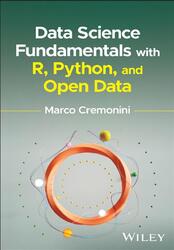
This text introduces the fundamentals of data science using twomain programming languages and open-source technologies : R and Python. These are accompanied by the respective application contexts formed by tools to support coding scripts, i.e. logical sequences of instructions with the aim to produce certain results or functionalities. The tools can be of the command line interface (CLI) type, which are consoles to be used with textual commands, and integrated development environment (IDE), which are of interactive type to support the use of languages. Other elements that make up the application context are the supplementary libraries that contain the additional functions in addition to the basic ones coming with the language, package managers for the automated management of the download and installation of new libraries, online documentation, cheat sheets, tutorials, and online forums of discussion and help for users. This context, formed by a language, tools, additional features, discussions between users, and online documentation produced by developers, is what we mean when we say "R" and "Python," not the simple programming language tool, which by itself would be very little.
R Language and RStudio.
In this first section, we introduce the main tools for the R environment: the R language and the RStudio IDE (interactive development environment). The first is an open-source programming language developed by the community, specifically for statistical analysis and data science; the second is an open-source development tool produced by Posit (www.posit.com), formerly called RStudio, representing the standard IDE for R-based data science projects. Posit offers a freeware version of RStudio called RStudio Desktop that fully supports all features for R development; it has been used (v. 2022.07.2) in the preparation of all the R code presented in this book. Commercial versions of RStudio add supporting features typical of managing production software in corporate environments. An alternative to RStudio Desktop is RStudio Cloud, the same IDE offered as a service on a cloud premise. Graphically and functionally, the cloud version is exactly the same as the desktop one; however, its free usage has limitations.
The official distribution of the R language and the RStudio IDE are just the starting points though. This is what distinguishes an open-source technology from a proprietary one. With an open-source technology actively developed by a large online community, as is the case for R, the official distribution provides the basic functionality and, on top of that, layers of additional, advanced, or specialistic features could be stacked, all of them developed by the open-source community. Therefore, it is a constantly evolving environment, not a commercial product subject to the typical life cycle mostly mandated by corporate marketing. What is better, an open-source or a proprietary tool? This is an ill-posed question, mostly irrelevant in generic terms because the only reasonable answer is, “It depends.” The point is that they are different in a number of fundamental ways.
Contents.
Preface.
About the Companion Website.
Introduction.
1 Open-Source Tools for Data Science.
2 Simple Exploratory Data Analysis.
3 Data Organization and First Data Frame Operations.
4 Subsetting with Logical Conditions.
5 Operations on Dates, Strings, and Missing Values.
6 Pivoting and Wide-long Transformations.
7 Groups and Operations on Groups.
8 Conditions and Iterations.
9 Functions and Multicolumn Operations.
10 Join Data Frames.
11 List/Dictionary Data Format.
Index.
Бесплатно скачать электронную книгу в удобном формате, смотреть и читать:
Скачать книгу Data Science Fundamentals with R, Python, and Open Data, Cremonini M., 2024 - fileskachat.com, быстрое и бесплатное скачивание.
Скачать pdf
Ниже можно купить эту книгу, если она есть в продаже, и похожие книги по лучшей цене со скидкой с доставкой по всей России.Купить книги
Скачать - pdf - Яндекс.Диск.
Дата публикации:
Теги: учебник по программированию :: программирование :: Cremonini :: Python
Смотрите также учебники, книги и учебные материалы:
Следующие учебники и книги:
Предыдущие статьи: