Artificial Intelligence (AI) and deep learning are among the most transformative technologies of our time. They are reshaping how we live, work, and interact with the world—driving innovations in finance, healthcare, manufacturing, and beyond. However, as deep learning models grow in scale and complexity, so do the challenges of implementing them efficiently, securely, and reliably.
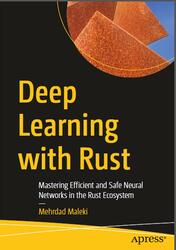
This book. Deep Learning with Rust, is written to bridge the gap between theoretical understanding and high-performance implementation. It combines the mathematical and conceptual foundations of deep learning with the engineering precision of Rust—a modern programming language designed for safety, concurrency, and performance.
By the end of this book, readers will not only understand how deep learning works but also how to build, optimize, and scale deep learning systems in Rust from the ground up.
Why Language Choice Matters in Deep Learning.
Deep learning demands significant computational power and efficient use of resources, particularly when working with large datasets or complex models. Thus, the choice of programming language plays a critical role in the performance, scalability, and reliability of deep learning applications.
Historically, deep learning research has leaned heavily on languages like Python, largely due to its extensive library ecosystem (TensorFlow, PyTorch, etc.) and ease of use. However, Python’s limitations in performance and memory efficiency have led developers to explore languages like Rust for specific applications. Rust offers low-level memory control, high performance, and strong concurrency support—qualities that make it well suited to meet the demands of modern deep learning.
In summary, deep learning combines powerful neural networks, vast data processing, and complex computations to solve advanced problems across industries. As the demands on these models grow, so does the need for efficient, high-performance programming languages like Rust, which we'll explore in detail in the next section. Here, we'll look at Rust’s potential to tackle the unique challenges of deep learning, providing a compelling alternative for those interested in scalable and high-performance AI applications.
Contents.
Part I Foundations of Deep Learning in Rust.
1. Introduction.
1.1. Introduction.
1.2. Introduction to Deep Learning and Rust.
1.3. Detailed Comparison of Programming Languages.
1.4. How to Use This Book.
1.5. Companion GitHub Repository for Source Code.
Problems.
2. Introduction to Deep Learning in Rust.
2.1 Introduction.
2.2. Overview of Deep Learning.
2.2.1. Foundational Concepts in Deep Learning.
2.2.2. Applications of Deep Learning.
2.2.3. Why Language Choice Matters in Deep Learning.
2.3. The Rust Advantage in AI Development.
2.4. Setting Up Your Rust Environment for AI.
2.4.1. Installing Rust.
2.4.2. Tips for Using rustup.
2.4.3. Cargo: Rust’s Package Manager.
2.4.4. Installing Essential Libraries (Crates).
2.4.5. Installing and Testing Linfa.
2.4.6. Optimizing Rust for AI Workflows.
3. Rust Syntax for AI Practitioners (Optional).
3.1. Introduction.
3.2. Rust Syntax and Concepts.
3.2.1. Basic Syntax.
3.2.2. Control Flow.
3.2.3. Functions and Return Values.
3.3. Structs and Enums for Data Representation.
3.3.1. Structs.
3.3.2. Implementing Methods for Structs.
3.4. Error Handling.
3.4.1. The Result Type.
3.4.2. The Option Type.
3.4.3. Error Propagation and the? Operator.
3.4.4. Best Practices for Error Handling.
3.5. Memory Safety in AI Workflows.
3.5.1. Borrowing and References.
3.5.2. Memory Allocation and Deallocation.
3.6. The Ownership Model for Data Handling.
3.6.1. The Ownership Concept in Rust.
3.6.2. Clone and Copy Traits.
3.6.3. Using Ownership in AI Workflows.
Problems.
4. Why Rust for Deep Learning?.
4.1. Introduction.
4.2. Why Rust?.
4.3. Lifetime and Scope in Rust and Their Importance in Deep Learning.
4.4. Performance Advantages of Rust in Deep Learning.
4.4.1. Why Rust Is Faster.
4.4.2. Example: CSV Data Preprocessing.
4.5. Concurrency and Parallelism in Rust for AI Workloads.
4.5.1. Performance Comparison: Rust vs. Python for Parallel Computation.
4.5.2. Benchmark Results.
4.5.3. Rust Code.
4.5.4. How Parallelism Works in Rust.
4.5.5. Python Code.
4.5.6. CPU Parallelism in the Age of GPU Compute.
4.6. Tooling and Ecosystem in Rust for Deep Learning.
4.6.1. Emerging Libraries in Rust.
Problems.
Part II Advancing with Rust in AI.
5. Building Blocks of Neural Networks in Rust.
5.1. Introduction.
5.2. Basic Neural Network Architecture.
5.2.1. Implementing Perceptron.
5.2.2. Implementing XOR with Perceptrons.
5.2.3. Forward Propagation.
5.2.4. Feedforward Pass for a Three-Layer Neural Network.
5.2.5. Automatic Differentiation with autodiff Crate.
5.2.6. Backpropagation Using Automatic Differentiation.
5.3. Plotting Graphs in Deep Learning with plotters Crate.
5.3.1. Plotting Simulated Training Loss in Rust.
5.3.2. Scatter Plot with plotters Crate.
6. Rust Concurrency in AI.
6.1. Introduction.
6.2. Concurrency vs. Parallelism.
6.3. Threads and Spawn in Rust.
6.4. Concurrency in Deep Learning Applications.
6.4.1. Concurrent Data Loading and Preprocessing.
6.4.2. Parallelizing Computation Across Layers.
6.4.3. Model Evaluation During Training.
6.4.4. Logging and Monitoring.
7. Deep Neural Networks and Advanced Architectures.
7.1. Introduction.
Chapter Goal.
7.2. Designing and Implementing DNNs in Rust.
7.3. Convolutional Neural Networks (CNNs).
7.3.1. CNN Building Blocks.
7.3.2. Implementing a Basic CNN in Rust.
7.4. Building a CNN From Scratch in Rust.
7.4.1. Step 1: Activation Functions.
7.4.2. Step 2: Loss Function.
7.4.3. Step 3: Convolution Operation.
7.4.4. Step 4: Convolution Backpropagation.
7.4.5. Step 5: Max Pooling.
7.4.6. Step 6: Max Pooling Backpropagation.
7.4.7. Step 7: Training the CNN Step by Step.
7.4.8. Using the Trained CNN for Prediction.
7.5. Recurrent Neural Networks (RNN).
7.5.1. RNNs as Dynamical Systems.
7.5.2. Fixed-Size Input/Output RNNs.
7.5.3. Variable-Size Input/Output: Encoder-Decoder (Seq2Seq).
7.5.4. Training RNNs.
7.6. A Minimal RNN in Rust with tch.
7.6.1. Context and Problem Statement.
7.6.2. Reading the Output.
7.6.3. How Each Line Mirrors the Equations.
7.7. Long Short-Term Memory (LSTM).
7.7.1. Why RNNs Struggle with Long-Term Dependencies.
7.7.2. The LSTM Solution.
7.7.3. Intuition Behind the Gates.
7.7.4. Mathematical Formulation.
7.7.5. Training LSTMs.
7.7.6. Architecture.
7.8. Implementing LSTM in Rust over the One-Shift Example.
7.8.1. What Stays the Same.
7.8.2. What Changes (and Why).
7.8.3. The Minimal Changes, Shown Side by Side.
7.8.4. Reading the Results.
7.8.5. Recap.
Problems.
8. Generative Models and Transformers in Rust.
8.1. Introduction.
Chapter Goal.
8.2. Generative Adversarial Network (GAN).
8.2.1. Min-Max Game.
8.2.2. Expectation for Real Data x.
8.2.3. Expectation for Fake Data G(z).
8.2.4. Objective Function Interpretation.
8.2.5. The Min-Max Problem.
8.2.6. Equilibrium.
8.3. A Minimal GAN in Rust with tch: Explanation and Walk-Through.
8.3.1. High-Level Flow.
8.3.2. Full Code (for Reference).
8.3.3. Explaining Each Part.
8.3.4. Notes and Tips.
8.3.5. What Success Looks Like.
8.3.6. Result Interpretation.
8.4. Transformers.
8.4.1. Architecture Overview.
8.4.2. Self-Attention Mechanism.
8.4.3. Positional Encoding.
8.4.4. Multi-Head Attention.
8.4.5. Feed-Forward Networks.
8.5. Transformers (A Meaningful Toy Task).
8.5.1. Task Definition.
8.5.2. Results and Analysis.
8.5.3. Code Walk-Through (Piece by Piece).
8.6. A Minimal Transformer for NLP in Rust.
8.6.1. What This Code Is Supposed to Do.
8.6.2. How It Works (High Level).
8.6.3. Architecture.
8.6.4. Complete Code.
8.6.5. Code. Piece by Piece.
Problems.
References.
Index.
Бесплатно скачать электронную книгу в удобном формате, смотреть и читать:
Скачать книгу Deep Learning with Rust, Maleki M., 2025 - fileskachat.com, быстрое и бесплатное скачивание.
Скачать файл № 1 - pdf
Скачать файл № 2 - epub
Ниже можно купить эту книгу, если она есть в продаже, и похожие книги по лучшей цене со скидкой с доставкой по всей России.Купить книги
Скачать - epub - Яндекс.Диск.
Скачать - pdf - Яндекс.Диск.
Дата публикации:
Теги: учебник по программированию :: программирование :: Maleki
Смотрите также учебники, книги и учебные материалы:

Следующие учебники и книги:

Предыдущие статьи: