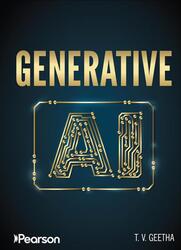
Generative AI, Geetha T.V.
Generative AI discusses the basics of generative AI, classification and types of deep models, applications, tools, evaluation and ethical perspectives of generative AI and hence enables learners to understand the mystic of generative AI from both academic and industry perspectives. An introduction on the connection between AI, machine learning, deep learning and generative AI is explained. The mathematical foundations required to assimilate deep generative models and their classification are discussed next. The book then goes onto to discuss various generative AI models including autoregressive models, variational autoencoders, generative adversarial networks, diffusion models, flow-based and energy based generative models and transformer models in detail. It also explains pre-trained language models and large language models including fine-tuning, prompt engineering and popular large language models such as GPT, BERT, T5, BART and EMO architectures. The book then discusses the varied applications of generative AI text, audio, conversational, image and video models and domain based applications in healthcare, advertising and marketing, manufacturing, finance, media and entertainment and education. The book also outlines the various tools available. The book also gives an overview of evaluation of generative AI and the ethical perspectives associated with generative AI. In addition, many exercises and activities are included to enable the reader understand concepts and apply them to build meaningful applications using the latest techniques.
Working of Generative AI.
Let us now discuss a simplified working of generative AI without going into details. The details will be explained in subsequent chapters. Generative AI uses neural networks and deep learning algorithms to identify patterns and generate new content based on these patterns. The training process of a generative model involves inputting a large dataset of examples such as images, text audio or videos. The model then analyses the patterns and relationships associated with the characteristics of the input data and a probability distribution associated with the input data is learnt. The model then continuously updates its parameters to maximize the probability in order to generate accurate output.
For example, when a generative model is given a large dataset of images of cats, the learnt distribution is sampled to create novel images of cats. During inference, the model adjusts its output to obtain the desired output (Figure 1.6 (a)).
Contents.
About Pearson.
Title Page.
Preface.
Acknowledgements.
About the Author.
Course Structure.
Chapter 1: Introduction.
Chapter 2: Deep Generative Models.
Chapter 3: Classification of Deep Generative Models.
Chapter 4: Autoregressive Deep Generative Models.
Chapter 5: Variational Autoencoders.
Chapter 6: Generative Adversarial Networks.
Chapter 7: Diffusion Based Generative Models.
Chapter 8: Flow-based and Energy-based Generative Models.
Chapter 9: Transformer Models.
Chapter 10: Pre-Trained Language Models and Large Language Models.
Chapter 11: Generative Al - Applications, Tools, Evaluation and Ethical Perspectives.
References.
Ниже можно купить эту книгу, если она есть в продаже, и похожие книги по лучшей цене со скидкой с доставкой по всей России.Купить книги
Купить .
Купить - pdf .
Дата публикации:
Теги: учебник по информатике :: информатика :: компьютеры :: Geetha
Смотрите также учебники, книги и учебные материалы:




Следующие учебники и книги:


Предыдущие статьи: